The Mummy Returns
Genre conservatism; Sondheim; Ancient Etruscans

O tempora, o mores, oh yes I am posting for the first time in well over a year!
I hope I can be forgiven for not maintaining the same already shaky level of engagement with The Culture during the first year and change of parenthood. The things I love about parenthood are obvious and abundant (a little guy coming up and laying his head on my arm? and I get to see him every day?) but I can also own up to mourning the things that are gone. Time without pressure. Dictating my own wake-up hour. Easy yeses to plans. Fewer than 184 colds a year. And the ability to write this goddamn substack. I’ve started half a dozen posts this last year - some I got quite far into - but finished none, because the moment passed (whither now my thoughts on Weapons and Longlegs) and I huffily returned to something I was being paid to write (boo hoo, I know).
In fact I’ve developed something of a dread about starting up again - surely 16 months postpartum should be enough time to pull together something decent to say?? Sadly for my agent, absolutely not. I think I have to accept that slow, small and silly is better than nothing - so my considered assessment of Philip Pullman’s The Rose Field (a very curious end to a very curious trilogy) will have to wait. Instead, please accept this scattergun offering of things you’ve mostly stopped thinking about. Imagine me with the serene authority of, well, your mum, who is still trying to recount the plot of a Poirot she saw in 1992. Andiamo!
…
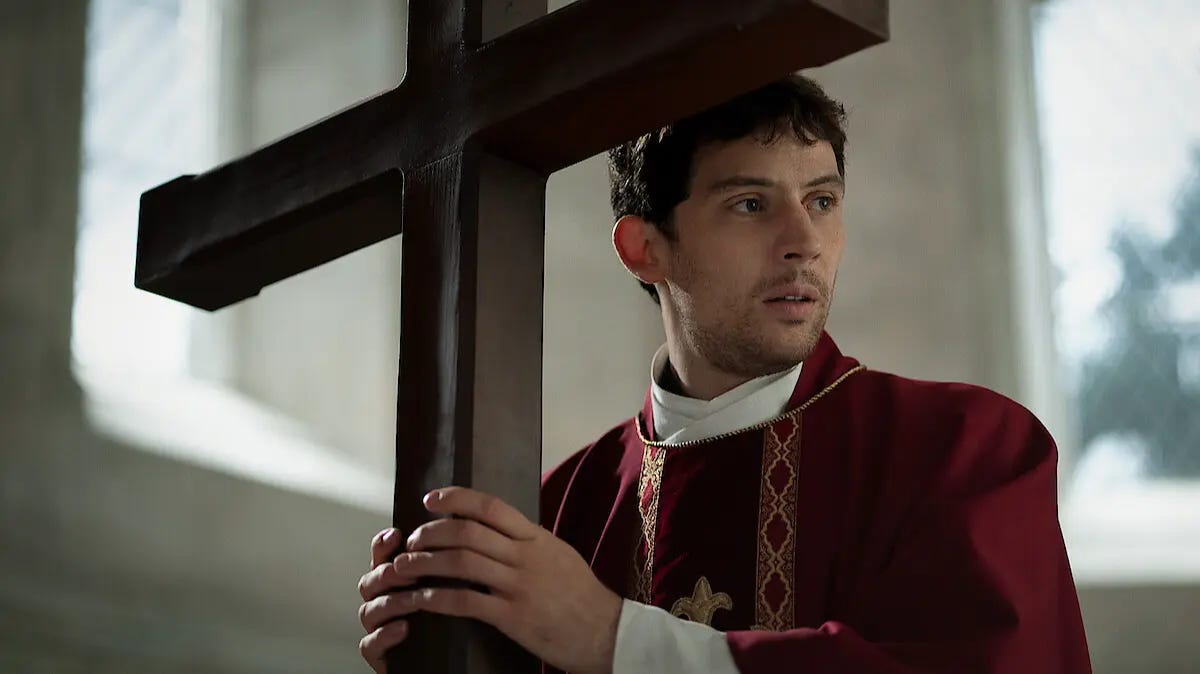
I saw Wake Up Dead Man three times. I didn’t mean to! I went to the cinema and then watched it on streaming with my partner and then we watched it again with his family over Christmas but you know what, it absolutely holds up to scrutiny, the best of the three imo. I love Rian Johnson even when he’s being a bit cute about his genre-cleverness and I love him EVEN MORE when he’s being sincere, and this is such a thoughtful/steely film about grace, of all things (and, as it turns out, Grace). I also did my first writers room recently and we referenced it a lot, so I am vindicated by a jury of my peers (television writers in their thirties).
…
The lack of time this year has meant my embrace of short form criticism1, by which I mean I now have a Letterboxd account. Sorry sorry. But also, this is my letterboxd account. I hope you enjoy judging my Top 4 and unsuccessful attempts to reconcile the Letterboxd One-Liner Review with sincere thoughts. Caveat: I take the view that you are always rating a film against itself and its project, hence why Trap is a 4 star Shyamalan film and The Substance is a 2.5 star feminist horror.
…
Pysch, you get to hear my Weapons and Longlegs thoughts anyway! tl;dr I’m not sure you can evoke the spectre of very real societal phenomena (school shootings2, family annihilation) largely rooted in violent patriarchy and then have your reveal be “what if an old gross woman/what if a perversion of the family unit where the father figure is kind of trans”. cf also The Monkey - I’m well aware of Oz Perkins’s own family history but at what point does excavating your own trauma about your gay dad simply become homophobia? (Also Amy Madigan Oscar winner eh? She’s great but I’ve got to say, I was surprised until I remembered the Academy simply loves to award Best Supporting Actress to an older woman doing ‘a turn’, and what is more of a turn than Baby Jane Aunt Gladys?) I’m sort of annoyed by what I perceive as the reductiveness of my own readings but I am stumbling over the grit in the shoe, and I do think not making accidentally right-wing art in a genre (horror) that often lends itself to conservatism (as does anything that dallies with big societal psychic fears) is worth a thought.
…
Speaking of being annoyed by my own readings, I wanted to love Lynn Ramsey’s Die My Love so much. Oh, a film about a new mother who is struggling to write, you say? I will take one catharsis, please! Sadly a) the film is not really about this particularly and b) I think I have to finally admit to just not being much of a JLaw person. She’s very good, and she’s good in this, but her gravitation towards defensive, prickly, closed-off characters yields diminishing returns for me at this point. In general, I love to sit in a vibe but I found the film elliptical and opaque to a fault, though I adored the scenes in the middle between Lawrence and Sissy Spacek playing her newly widowed mother in law, where it felt like the film suddenly flowered into something much more multi-dimensional and alive. Mainly I find it interesting that Die My Love made me feel annoyed at myself - it’s so obviously a film that either does it for you or doesn’t in a way that can easily be framed as you either ‘got’ it or you didn’t, and such is my vanity that I hate feeling like I didn’t ‘get’ something.
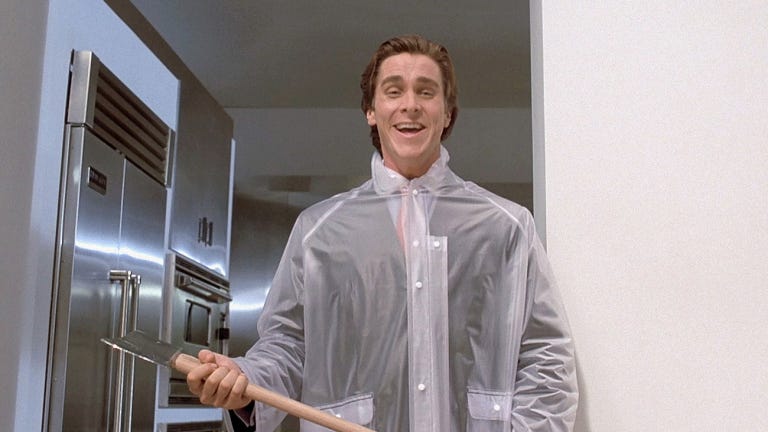
[Side note: I’ve now been critical of two female filmmakers in a matter of paragraphs. Why is this? Internalised misogyny always a possibility, of course, as is small sample size. But when I think about a film by a woman I love, the one that comes to mind is American Psycho. Is it possible I actually love a certain type of film that women don’t often (get to) make? Possibly! Maybe I am just a big old sexist though. But I am so - no other word for it - charmed by American Psycho, one of the few adaptations that outshines its source by recognising its potential to transform into something else. Namely Mary Harron, Guinevere Turner and (to give him his due) Christian Bale really got that at heart it’s one for the girls and the gays, and no amount of besuited chuds lining up to identify with the thing that is mocking them can change that for me.]
…
I have been really enjoying the return of Exeunt in Substack form, including Frank Peschier’s attempt to reckon with just not liking Sondheim that much via the medium of Into the Woods, done two ways (the current revival at the Bridge, and the 2014 film). As something of a Sondheim agnostic, here is my mean assessment: people like to sing Sondheim much more than people like hearing Sondheim being sung, and thusly most revivals are attended by theatre kids (who know it might one day be their turn to Sing Sondheim) and non-singers (enjoying limited returns), and you can spiritually divide audience response into those camps.
And lbr, people get weird about Sondheim the same way a certain species of comedy bro got weird about David Cross’ performance in Arrested Development in the mid 2000s, more a way of displaying you have good taste than an actual indicator of it.3 Adam Driver singing ‘Being Alive’ in Marriage Story? That’s Mr Greta Gerwig getting weird about Sondheim, sorry to say! But I also think Frank has chosen the worst possible Sondheim to test herself on - because isn’t Into the Woods actually quite a quietly broken musical? It’s fascinating when you have a show that actually needs to be fixed and made about something, but no one will quite admit it. I really loved Follies at the National sort of because everyone knows it’s weird and imperfect and kind of unfinished, and that made the production feel like a heartfelt offer, rather than an instruction to admire. She also singles out a lyric from Sweeney Todd as her (second) least favourite - may I counter with Wicked’s “like a seed dropped by a sky-bird” because WHAT OTHER KIND OF BIRD WOULD IT BE STEPHEN SCHWARTZ, IT CAN’T BE THAT HARD TO MAKE SOMETHING SCAN
…
We managed a cinema trip to see 28 Days Later: The Bone Temple - loved it (cf my Letterboxd) but I actually want to mention that during the trailers we had to sit through previews for Emerald Fennel’s Wuthering Heights followed by Christopher Nolan’s The Odyssey, at which point I audibly growled “don’t piss me off” - and THEN Riz Ahmed’s Hamlet, at which point the sun burst through the metaphorical clouds because it looks so COOL, and neither self-conscious (a la Wuthering Heights) nor boring (a la The Odyssey). Maybe a full length substack about adaptation of classical texts beckons when I have seen all these films and hey, maybe I will be dead wrong about all three but…probably not, right? (Also predictably the worst people in the world are being normal about Lupita Nyong’o’s casting as Helen of Troy but this is a huge W for me personally, who has long considered her to be - and described her as - the most beautiful woman in the world.)
…
Bridgerton came back and oh lord, with it, the discourse. Sometimes I hop over to Threads to see what’s going on there4 and what’s going on there needs to be studied. Whoever said ‘a little education can be a dangerous thing’ etc etc because it’s all loud yelling about what is and isn’t period accurate with the confident wrongness that can only be acquired from watching Joe Wright’s Pride and Prejudice too many times. This season (loosely) concerned itself with class and the taking of mistresses via a Cinderella relationship between a Bridgerton son and a maid (but don’t worry because she actually has an aristocratic father who taught her French and Latin and she sounds RP). Like horror, romance/historical romance is so easily conservative - the biennial Bridgerton watch for me has become a sort of queasy anticipation of the Shondaland quandary of reconciling the Regency era with the early 2000s when the books were written with contemporary broadly Gen Z eyes. I think the show often takes the path of least resistance, which is to say it pick’n’mixes which era’s mores are uppermost at any one time depending on vibes. It’s an extremely algorithm-y way of proceeding, the kind of nervous tightrope-walking that comes from having one eye on the TikToks, and not my preferred approach. All of which is to say no subsequent season has yet rivalled the noise I produced during Season 1 when I realised I was watching a plot line about the pull-out method.
…
New hyper-fixation download: I’ve been thinking about the ancient Etruscans for the first time in my life, the Iron Age indigenous Italians with at one point greater territory than the upstart Latins. Obviously history went the way of the Latins on that one and the Roman Empire was the result, which feels like such a clear jumping off point for counter-factualist history. If the Etruscans had won that war, would we be talking about a world shaped by the Etruscan Empire, or, absent the colonial drive and obsessive military prowess of their cousins, would they have stayed neatly confined to Northern Italy? The entire modern day organisation of Europe and the Middle East might look different - and there might be no bagels (no sacking of Jerusalem, no enforced Jewish diaspora, and so perhaps no Ashkenazis/the total absence of Jewishness as a European identity at all, hence no bagels, no lox, no schmaltz, no chrain).
Would our language, shaped by Etruscan rather than Latin, or simply just without Latin, sound completely different? What authors would we have instead? The little extant Etruscan we have is largely undecipherable, a language and culture and religion only glimpsed, though it seems to have been broadly a more permissive and less patriarchal society than the Romans (not difficult). They seem to have had three pantheons of gods - ground level, sky level, and then a third, more mysterious tier - the dii involuti, the hidden gods (incredibly metal), to whom even Tinia (their Zeus/Jupiter sky-lord equivalent) had to ask permission to throw his lightning bolts. But then again, the Etruscans themselves can’t tell us - their language is gone - and most of what we know was written centuries later by vaguely suspicious Roman writers. They might have been better, they might have been the same - they might have been worse. It’s all relative and unknown, so instead we have these half-seen people who left a handful of tombs and distorted reflections in the reportage of the historians of their conquerers.
It’s not the first time I’ve come across them (they’re the baddies in the final books of The Aeneid, which I studied at A Level) but this time my memory was jogged by a 1919 short story by Thomas Graham Jackson5 - a very M.R. James type tale of a young academic taking a ring from an Etruscan tomb in a region of Italy where belief in the ‘old religion’ persists alongside Catholicism, and suffering the consequences. It’s fairly standard early 20th century horror - lightly xenophobic in an impressed ‘mysterious heart of paganism, forces we wot not of’ kind of way - but it did touch a part of me that contains the absurd and telling fantasy that being a young, monied white male academic a hundred years ago at the relative infancy of new disciplines like ‘archeology’, swanning about the continent, is ultimately the dream.
…
I’m reading Katabasis by R.F. Kuang, which is probably her least well-received work but sometimes an author is marketed to you so aggressively that not reading Yellowface or Babel counts as an act of rebellion. Anyway I’m enjoying it fine, concerning as it does a journey through hell undertaken by two post-graduate magicians from an alternate Cambridge University where ‘analytic magick’ is a field of study.6 The mishmash of mythologies and semi-regurgitated philosophical paradoxes is unfortunately right up my street - imagining each of the literary journeys through the underworld (Dante etc) as a form of travel writing recorded by people who have actually been is a fun concept. However, the book is bringing me front and centre with a specific ick I have, which is to say, the woes of the PhD student. Don’t get me wrong, poor labour conditions are poor labour conditions and I know from people dear to me (‘some of my best friends are post-grads’) that overworked and underpaid is just the start of it BUT. I can never get away from the eye-roll reflex occasioned by so much fiction and memoir (not my friends, who are perfect and discerning) which defaults to presenting these woes as something that - bluntly - matters to the world. As if a post-grad degree wasn’t by its nature the most self-imposed struggle of all time. Idk, critical empathy failure from me here, but it doesn’t help that this book seems to contain a fetishisation of this very state, at the same time as purporting to be critiquing it. A long way of saying I’m finding it hard to care about these protagonists and their journey into hell to revive their PhD supervisor, which should be satire but isn’t satire enough.
…
Right, that’s enough of a brain dump. Thank you for indulging me - pinning one multipartite thought down to a coherent post with structure and interest is a muscle, and I’ve been on a long layoff, so these little reps of opino-criticism are good for me. Hopefully next time I will emerge from my cave frighteningly intellectually buff like the poster equivalent of Uncle Iroh breaking out of prison. Until then, I leave you with the thought that I wrote some of this in the library where an actual meet-cute was happening at the next table. And this is why we need libraries.
I’m well aware no-one could accuse me of being a short-form writer. One of my friends at university used to say I wrote such long essays because I stored up all the words in my cheeks like a hamster, which let’s say is cute.
I know Zach Cregger said Weapons wasn’t about school shootings but c’mon, the author has never been more dead.
I rewatched Arrested Development recently - it’s not that David Cross isn’t brilliant, it’s that the character of Tobias was lauded as such a specific masterstroke of comic creation when a) GOB and Buster are right there, and b) come on now, it’s mostly gay jokes.
I only post on Bluesky now, broadly an uneasy alliance between Quite Fed Up Actually left-of-centrists and 40 year old trans shitposters.
The story was in this brilliant collection published by the British Library, part of a series anthologising (mostly early 20th c) tales of the Weird. This one on horror inspired by ancient mythologies was out of stock as a physical edition so I read it on Kindle and comforted myself by buying three more in print.
Another thing I am struggling with is that magic doesn’t seem to do anything in this universe beyond literalise philosophical paradoxes, making it all feel like a parlour trick. The idea that people would gamble their lives away on a pointlessly narrow slice of academia with no real application does absolutely ring true but as a story it makes the stakes pretty low. And as for magic as something hoarded by and only of interest to a group of old-school male academics, unfortunately Kuang runs into the same pitfall so many fantasy writers do - Terry Pratchett got there first.